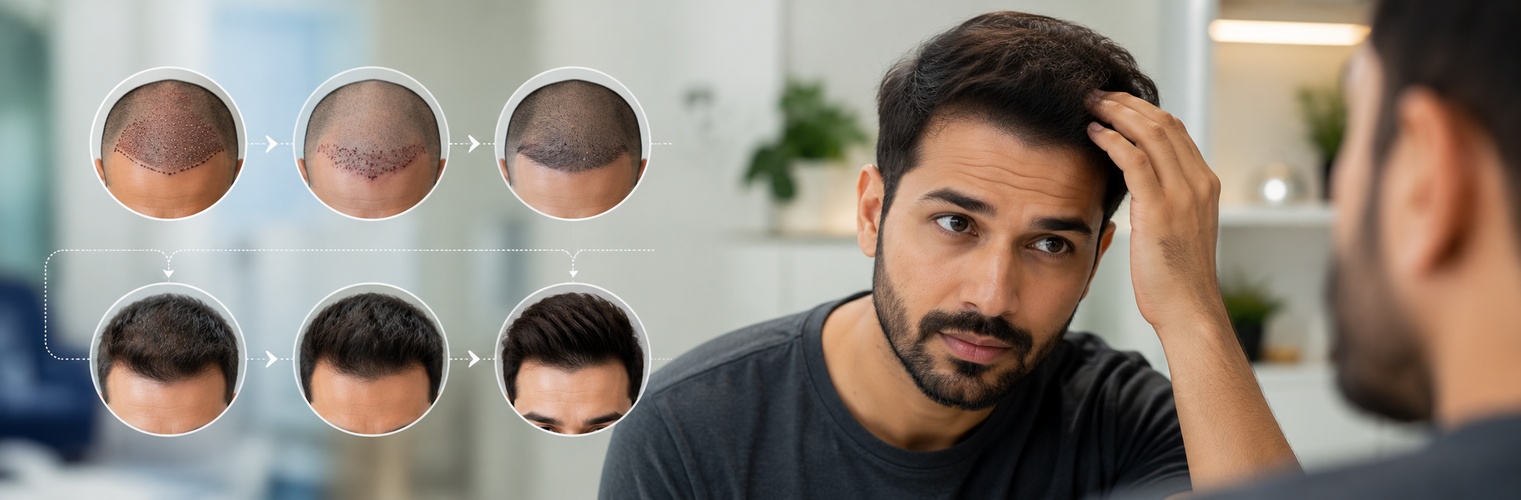
A hair transplant can be an exciting step toward restoring a fuller and more natural-looking hairline, but the actual results do not appear overnight. Understanding the hair transplant recovery timeline can help you know what is normal during each stage and avoid unnecessary worry when the transplanted hair starts shedding. Recovery involves two different processes: healing of the scalp and gradual growth of new hair from the transplanted follicles. While most people become comfortable within a few weeks, visible hair growth usually takes several months, and the final outcome may take up to 12–18 months.
This 2026 guide explains what you may experience after a hair transplant, from the first few days to the one-year milestone, along with practical hair transplant aftercare tips.
Understanding the Hair Transplant Recovery Timeline
The recovery period is different for every patient. The technique used, number of grafts, individual healing response, scalp condition and adherence to post-procedure instructions can all influence recovery.
A general timeline looks like this:
|
Recovery Stage |
What Usually Happens |
|
Days 1–7 |
Redness, mild swelling, tenderness and small scabs |
|
Weeks 2–4 |
Scabs reduce and transplanted hair may begin shedding |
|
Month 1 |
Scalp continues healing; visible growth is usually limited |
|
Months 2–3 |
Resting or “quiet” phase for many transplanted follicles |
|
Months 4–5 |
Early new hair growth may become noticeable |
|
Months 6–9 |
Density and coverage gradually improve |
|
Months 10–12 |
Hair becomes thicker and more mature |
|
Months 12–18 |
Final refinement may continue |
These are general milestones rather than strict deadlines. Some people see growth earlier, while others require more time.
Hair Transplant Recovery: Month-by-Month Guide
First Week: The Initial Healing Phase
The first week is mainly about protecting the newly transplanted grafts. Mild redness, swelling, tenderness, tightness, itching and small scabs can occur during this period.
Swelling may become more noticeable during the first few days before gradually settling. Your surgeon may provide specific instructions about washing, sleeping position, medications and scalp care.
During this stage:
Many patients can return to desk-based work within several days, although this depends on the procedure and individual recovery. Cleveland Clinic notes that light activities and work may often resume within a few days, while exercise or sports may require a longer break.
Month 1: Healing and Shedding
By the first month, most of the visible scalp irritation should have reduced. However, this can also be the stage when patients become concerned because transplanted hairs may start falling out.
This is commonly known as shock shedding or shock loss. The visible hair shaft can fall while the transplanted follicle remains beneath the skin. The follicle then enters a resting period before producing a new hair.
So, seeing less hair during this period does not automatically mean that the transplant has failed.
The most important thing during month one is patience. Continue following the aftercare plan provided by your hair restoration specialist rather than trying new products or treatments without professional advice.
Month 2: The Quiet Phase
Month two can be psychologically challenging because there may not be much visible improvement. The scalp may look similar to how it appeared before the procedure, particularly after the initial transplanted hairs have shed.
This does not mean that nothing is happening. Hair follicles have their own growth cycles, and new growth takes time.
Instead of judging your progress every day, take photographs at consistent intervals. Monthly photographs taken under similar lighting and from the same angles can provide a much better comparison.
Month 3: Waiting for New Growth
Around the third month, some patients begin noticing early signs of new growth, while others may still see very little change. Cleveland Clinic states that transplanted hairs may fall out after the procedure and may not begin regrowing for approximately three months.
If new hairs begin appearing, they may initially be:
This is a normal part of the development process. The early hairs still need time to mature.
Month 4–5: Early Hair Growth
This is often when the recovery journey becomes more encouraging. New hairs may start becoming easier to see, particularly around the hairline and other treated areas.
However, early growth should not be confused with the final result. The hairs may still appear thin and irregular.
A common mistake is comparing your month-four result with someone else's month-four photograph online. Hair transplant results vary considerably between individuals, so another person's timeline is not a reliable prediction of your own.
Month 6: Noticeable Improvement
By approximately six months, many patients begin seeing a clearer cosmetic difference. Hair coverage can look better, and transplanted hairs gradually become stronger and thicker.
This is an important milestone, but it is still too early to judge the final outcome. Hair continues to mature after the six-month point, and some areas may develop more slowly than others.
If your clinic schedules a follow-up around this time, it is a good opportunity to discuss growth, density and the condition of both transplanted and existing hair.
Months 7–9: Increasing Density
During months seven through nine, the changes may become more noticeable. Newly growing hairs can become thicker, darker and better integrated with existing hair.
The hairline may begin looking more natural, while areas such as the crown can sometimes take longer to show substantial improvement.
At this stage, continue your recommended hair transplant aftercare routine and attend follow-up appointments. Do not assume that reaching six months means recovery is complete.
Months 10–12: Approaching the Final Result
By months 10 to 12, many patients have experienced substantial improvement. Hair generally appears more mature, and the transplanted area can blend more naturally with surrounding hair.
This is also the period when it becomes easier to assess the overall result. However, reaching the 12-month mark does not necessarily mean every patient has reached the absolute final stage.
Some individuals, particularly those with slower growth, may continue seeing gradual changes beyond one year. Medical sources commonly note that full hair transplant results can take around a year, while some recovery timelines extend to 12–18 months.
Months 12–18: Final Maturation
The final phase is about refinement rather than sudden transformation. Hair can continue becoming thicker and more natural-looking as the transplanted follicles mature.
At this stage, your specialist can evaluate the overall density, hairline, graft survival and appearance of the transplanted area.
It is important to remember that a hair transplant moves hair follicles into areas affected by hair loss; it does not necessarily stop future thinning of untreated native hair. Long-term hair-loss management may therefore remain relevant for some patients.
What Can Affect Your Hair Transplant Recovery?
Recovery does not follow exactly the same pattern for everyone. Several factors can influence the timeline, including:
The best approach is to use your own progress and your specialist's follow-up assessments rather than comparing yourself with online before-and-after photographs.
Hair Transplant Aftercare Tips for Better Recovery
Good aftercare helps protect the grafts while the scalp heals. Your clinic's instructions should always take priority, but general precautions may include:
Recovery is a gradual biological process, so trying to accelerate it with unapproved products or excessive treatments can be counterproductive.
When Should You Contact Your Hair Transplant Specialist?
Some discomfort, redness, swelling and scabbing can be part of normal healing. However, you should contact your healthcare provider if you notice symptoms that concern you, especially if they are severe, worsening or different from what you were told to expect.
Your surgeon is the right person to determine whether a particular symptom is part of normal recovery or requires assessment.
Conclusion
The hair transplant recovery timeline is a gradual journey rather than a quick transformation. The first few weeks are mainly focused on scalp healing, while the following months involve shedding, resting and gradual regrowth. Around months four to six, early improvement may become visible, while months six to twelve generally bring more noticeable density and maturation. Some patients may continue seeing changes for 12–18 months.
The most important part of recovery is following professional aftercare instructions and giving your transplanted follicles enough time to complete their natural growth cycle. If you are considering a hair transplant or want to understand what recovery could look like for your individual case, consult the specialists at Soul Derma for personalised guidance.
FAQs About Hair Transplant Recovery Timeline
1. How long does hair transplant recovery take?
Initial scalp healing commonly takes a few weeks, but complete hair growth takes considerably longer. Visible improvement develops gradually, and the final result may take around 12 months or, in some cases, 12–18 months.
2. Is hair shedding normal after a hair transplant?
Yes. Transplanted hair shafts can shed after the procedure as the follicles enter a resting phase. This can be alarming, but shedding does not necessarily mean the transplanted follicles have been lost.
3. When does new hair growth start after a transplant?
New growth commonly begins around the third or fourth month, although the exact timing varies. Early hairs may be thin and fine before gradually becoming thicker.
4. When will I see noticeable hair transplant results?
Many patients begin noticing clearer cosmetic improvement around six months. However, density and hair thickness can continue improving through months nine to twelve and beyond.
5. Can I exercise after a hair transplant?
Exercise should generally be limited during the early recovery period. The exact time for returning to workouts depends on the procedure and your surgeon's instructions. Cleveland Clinic notes that returning to exercise or sports may take around three weeks.
6. Why does my hair look worse two or three months after transplantation?
This can happen because transplanted hair may shed while the follicles enter a resting phase. The temporary appearance can be frustrating, but new growth may follow in the coming months.
7. When can I expect the final hair transplant result?
A final assessment is often made around 12 months, although some patients continue to experience maturation and density changes for up to 18 months.
8. Is hair transplant recovery the same for everyone?
No. Recovery depends on factors such as the number of grafts, technique, individual healing, hair-growth cycle and aftercare. Your surgeon can provide a more personalised recovery expectation based on your procedure

Basement W-58, Greater Kailash I, New Delhi, Delhi 110048 India