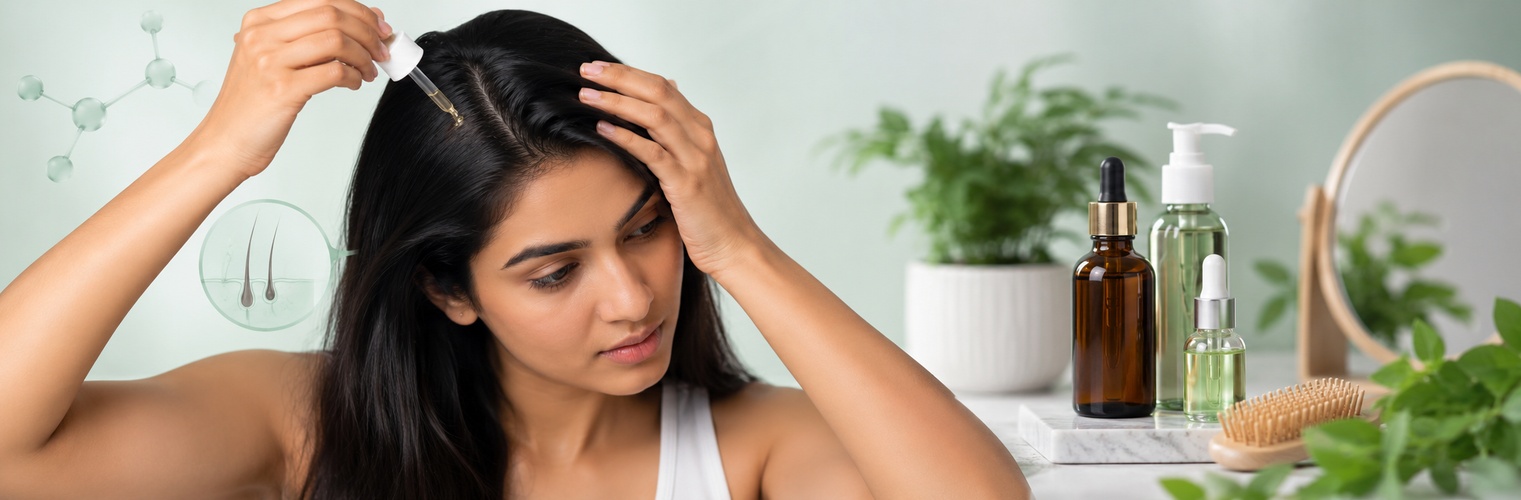
Hair fall can be frustrating, especially when you start noticing more strands on your pillow, comb, or shower drain. This is why hair growth serums have become a popular part of hair-care routines. But do hair growth serums really work, or are they simply another beauty product with attractive claims? The answer depends on the ingredients, the cause of hair loss, and how consistently the product is used. Some serums can support scalp health, reduce breakage, and improve the appearance of hair density, while evidence for actual regrowth varies significantly between ingredients. Dermatologists also emphasize that hair loss is not a single condition, so identifying its cause is an important first step.
Hair growth serums are leave-on products designed to be applied directly to the scalp. Unlike conventional hair oils or conditioners, they usually contain concentrated active ingredients intended to support the scalp environment or hair follicles.
Depending on the formulation, a serum may aim to:
However, not every serum has the same purpose. A cosmetic serum containing peptides or botanical ingredients should not automatically be considered equivalent to a medically proven hair-loss treatment.
Yes, some can help, but expectations should remain realistic. The effectiveness of a hair growth serum depends largely on its active ingredients and the reason behind your hair loss.
For example, minoxidil has considerably stronger clinical evidence for certain types of hair loss than many cosmetic serum ingredients. It can stimulate hair growth and help thicken miniaturized hairs.
On the other hand, ingredients such as Redensyl, AnaGain, Procapil, peptides, and rosemary-based formulations are commonly found in cosmetic hair serums. Some have promising preliminary research, but the strength and quality of evidence are not comparable with established medical treatments.
This means a serum may be useful for some people, but it should not be viewed as a universal cure for hair loss.
One of the biggest misconceptions is that every hair serum can regrow lost hair. In reality, there is an important difference between supporting hair health and treating a medical hair-loss condition.
|
Hair Growth Serum |
Medical Hair-Loss Treatment |
|
Usually focuses on scalp and hair support |
Targets a diagnosed cause or condition |
|
May contain peptides, botanical extracts or cosmetic actives |
May include clinically established medications |
|
Results vary between formulations |
Evidence depends on the specific treatment |
|
Usually requires consistent application |
May require long-term medical supervision |
|
Often suitable for early or mild concerns |
Used when hair loss requires targeted treatment |
A dermatologist can determine whether a serum is appropriate or whether another treatment is needed.
When choosing a hair growth serum, do not focus only on phrases such as “advanced growth formula” or “anti-hair fall.” Check the actual ingredient list.
Minoxidil
Minoxidil is one of the best-established topical treatments for certain forms of pattern hair loss. It can encourage hair growth and help maintain existing hair. However, it is a medication rather than simply a cosmetic serum, so it is best used according to appropriate medical guidance.
Peptides
Peptide-based formulations are increasingly used in scalp serums. They may help support the scalp and hair-fibre environment, although evidence varies considerably between individual products and formulations.
Redensyl and Similar Actives
Redensyl, AnaGain, and Procapil are frequently marketed for hair thinning. There are smaller studies and manufacturer-linked evidence around these ingredients, but consumers should be careful about treating marketing claims as equivalent to large clinical trials.
Rosemary and Botanical Ingredients
Rosemary and other botanical extracts are popular in hair-care products. They may have potential benefits, but “natural” does not automatically mean effective or suitable for everyone.
Hair does not grow overnight, so patience is essential. Depending on the cause of hair loss and the active ingredient, visible improvement may take several months.
Using a serum for only a few weeks and immediately declaring it ineffective may not provide enough time to judge the result. Consistency also matters. Applying a product occasionally is unlikely to produce the same results as following its recommended routine.
It is also useful to take photographs every few weeks under similar lighting. This can make gradual changes easier to notice than simply checking your hair in the mirror every day.
A serum may not be enough when hair loss is sudden, severe, or continuing despite regular care. Hair loss can be associated with genetics, hormonal changes, nutritional deficiencies, illness, medications, stress, and several scalp or medical conditions.
Consider consulting a dermatologist if you notice:
A dermatologist can examine the scalp and, when appropriate, recommend investigations to identify nutritional deficiencies, hormonal problems, infections, or other underlying causes.
Even a well-formulated serum may deliver limited benefits if it is used incorrectly.
Follow these simple steps:
Remember that gentle hair care also matters. The American Academy of Dermatology recommends gentle cleansing and conditioning because thinning hair can be more vulnerable to damage and breakage.
Buying the most expensive serum does not guarantee better results. Avoid products that promise dramatic regrowth within a few days or weeks.
Other mistakes include:
The AAD also cautions against taking unnecessary supplements because excessive amounts of certain nutrients can actually contribute to hair loss.
Hair growth serums can be useful, particularly when the goal is to support scalp health, reduce breakage, or manage early hair concerns. However, their effectiveness depends on their ingredients, formulation, consistency of use, and the underlying cause of hair loss.
The most important point is that hair loss is a symptom rather than one single condition. A dermatologist can help identify what is causing it and whether a cosmetic serum, medication, or combination approach is more appropriate.
If you are experiencing persistent hair fall or thinning, consult the experts at Soul Derma for an individualized assessment and guidance based on your scalp and hair concerns.
1. Can hair growth serum regrow lost hair?
Some medically established topical treatments can promote regrowth in specific forms of hair loss. Cosmetic serums may support scalp health and hair quality, but their regrowth evidence varies by ingredient and formulation.
2. How often should I use a hair growth serum?
Follow the instructions provided with the specific product. Using more serum than recommended does not necessarily produce faster results and may increase the risk of scalp irritation.
3. How many months does a hair growth serum take to work?
Hair growth is gradual. Depending on the product and underlying condition, noticeable changes may take several months. Consistency is important when evaluating any treatment.
4. Is minoxidil a hair growth serum?
Minoxidil is a topical medication used for certain types of hair loss. It may be formulated as a solution or foam and should be distinguished from ordinary cosmetic scalp serums.
5. Can hair serum stop hair fall completely?
No serum can guarantee that hair fall will stop completely. Hair shedding has many possible causes, and effective management depends on identifying and addressing the underlying reason.
6. Are natural hair growth serums effective?
Natural ingredients may provide supportive benefits, but natural does not automatically mean clinically proven. Look at the available evidence, formulation, and suitability for your particular scalp concern.
7. Can I use hair growth serum every day?
Some products are designed for daily use, while others have different directions. Always follow the product instructions and discontinue use if you develop significant irritation.
8. When should I consult a dermatologist for hair loss?
Consult a dermatologist when hair loss is sudden, persistent, severe, associated with bald patches or scalp symptoms, or when your hair continues to thin despite regular care

Basement W-58, Greater Kailash I, New Delhi, Delhi 110048 India